

Countries Get Old: Is America’s Descent into Authoritarianism Inevitable?
Karl Popper & Giambattista Vico on Barbarity.

In the weeks following Charlie Kirk’s assassination, a chilling effect on free speech spread across the country. Within days Jimmy Kimmel’s show was suspended “indefinitely” after threats from the FCC. Firings multiplied from Texas to Clemson, as teachers, journalists, and legislators who said the wrong thing about Kirk’s killing were swiftly censured. This latest wave is part of a broader harshening of public life that has seen universities punished, tourists imprisoned, law firms neutered, and reporters made to sign loyalty oaths. The penalties have been piling up almost as quickly as the think pieces proclaiming America’s descent into authoritarianism. “This is how Trump ends democracy,” “This is what authoritarianism looks like,” two recent headlines exclaim. Even the usually urbane PBS NewsHour carried Jonathan Capehart’s remarks that, “People say we’re sliding into authoritarianism. I say, no—we’re in it.”
Despotism is simply in the nature of nations, as unstoppable as a cicada shedding its molt.
Two things are striking about this moment. The first is how readily the health of the nation is identified with the fortunes of its ruling class. For years, those most exposed yet least powerful (teachers, local reporters, immigrants) faced sanctions. Yet the charge of authoritarianism seems only to become serious once the country’s most visible elites are made to suffer.
The second is the way this moment is spoken about with inevitability. As someone summarized today’s news to me: “countries get old.” Despotism is simply in the nature of nations, as unstoppable as a cicada shedding its molt. This certainty about our authoritarian fate raises a fundamental question: Is democratic backsliding a law of history, or does believing in such laws create the very collapse we fear?
To make sense of this moment, I have lately found myself returning to two thinkers who offer radically different diagnoses: Karl Popper and Giambattista Vico. Popper’s The Open Society and Its Enemies feels newly relevant after the administration’s announcement that it would pursue a RICO action against George Soros’s Open Society Foundations (Soros was Popper’s student). In his work, Popper argues that societies do not collapse into despotism due to what he calls “immutable historical tendencies.”1 Rather, the belief that authoritarianism is inevitable becomes a self-fulfilling prophecy. Once we accept that history and nations follow set laws, we surrender our capacity for rational intervention and democratic resistance.
Vico, the woefully overlooked eighteenth-century Neapolitan philosopher, has a more somber take on what he calls the “nature of nations.” In The New Science, Vico argues that nations follow corsi e ricorsi, cycles of recurrences, where nations rise from primitive terror through heroic aristocracy to rational democracy, only to collapse back into barbarism.2 The terminal phase arrives when excessive rationality breeds what Vico calls la barbarie della riflessione, the “barbarism of reflection.” In this final stage, citizens become isolated calculators of private advantage, wielding sophisticated reason to justify savage impulses, turning away from community, dissolving every bond of trust even while packed together in dense cities. For Vico, every nation passes through the barbarism, only to re-emerge and begin the cycle over again. This is the law of recurrence.
Popper’s Anti-Historicism
For Popper, such thinking is hogwash. Indeed, it’s not a stretch to characterize Popper’s entire project in The Open Society as a powerful rejection of the belief that nations and civilizations are subject to predetermined cycles of fate, or what he calls “immutable historical tendencies.” Such an idea, Popper lays at the feet of a virulent strain in the social sciences he calls “historicism.” For Popper, historicism is a kind of methodology that claims the task of social science is to predict the long-term future of society by discerning these historical laws of development, akin to something like astronomy.
His catalogue of historicists span millennia, beginning first with the ancient tribal “doctrine of a chosen people,” the belief that a particular group carries out a divinely ordained historical destiny. But it’s Heraclitus who first gives this impulse philosophical form around 500 B.C.
Having watched the tribal aristocracies of his day yield to nascent democracy, Heraclitus witnessed “natural” hierarchies crumble. His response wasn’t to deny change but to locate the singular rule governing it. For Heraclitus, most known for his dictum “everything is in flux,” the changing world was governed by one single immutable law: fire. All material things “whether solid, liquid, or gaseous” were processes of changing fire. Earth is merely cooled ash awaiting reignition; water evaporates into air that feeds flames; oil is combustion in waiting. All things transform into fire and fire into all things, “just as gold for wares, and wares for gold.”
As Popper reads him, this wedding of flux to a singular law plants the seed of historicism. Once change itself is thought to unfold under a determinate law, the slide from natural law to “historical” or “evolutionary” law is close at hand, and history is reimagined not as contingent human action but as the working-out of a cosmic script.
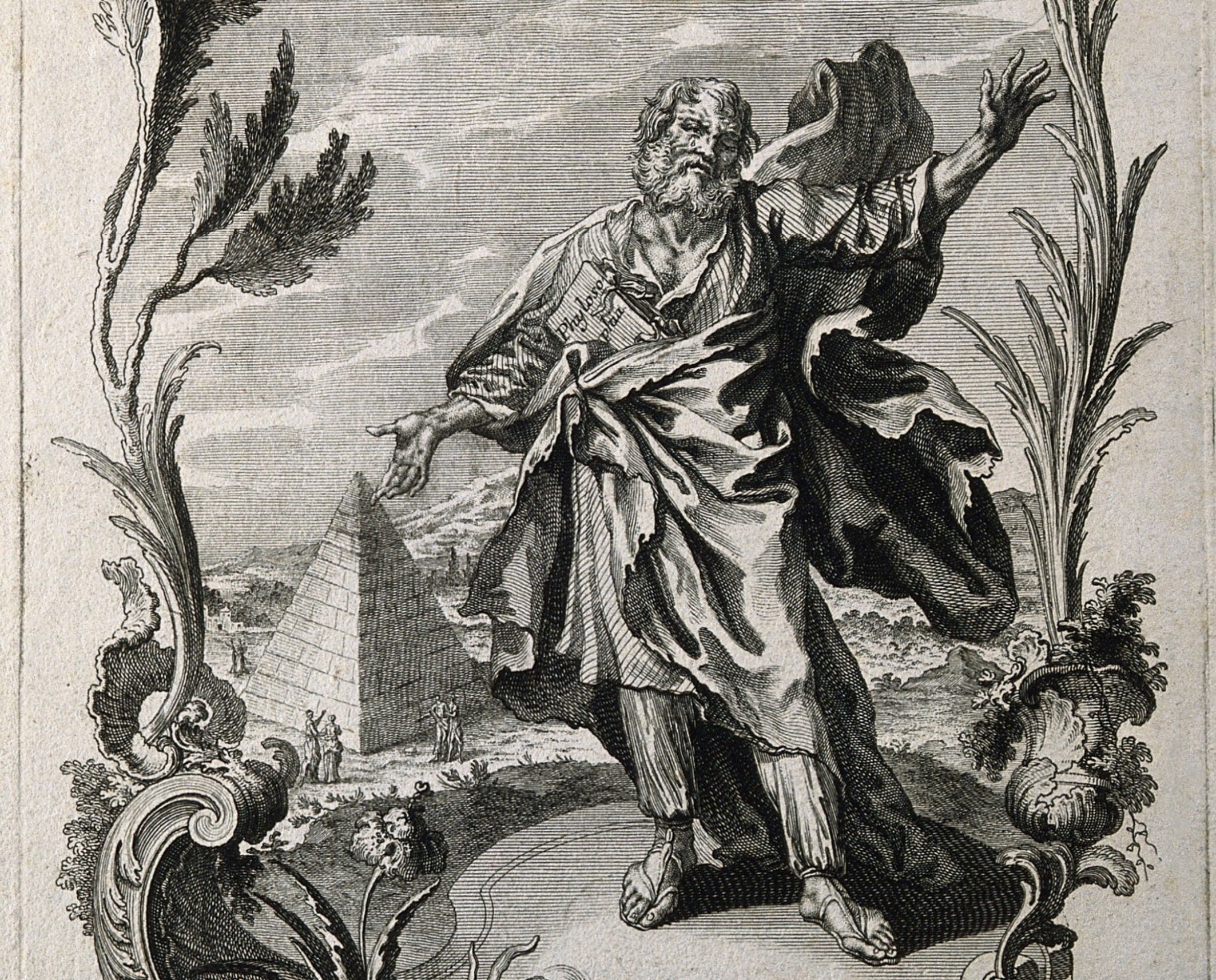
Heraclitus. Detail of a line engraving by B. S. Setlezky after G. B. Göz, ca. 1750.
In Popper’s reconstruction, Heraclitus’ law of fire lays the groundwork for what he calls “methodological essentialism.” This is the conviction that the task of knowledge is to expose the true concealed essence of things that appear to be changing all the time. This poses both a challenge and a temptation for the social scientist. Because social life is in constant motion, essentialism tempts the scientist to stabilize it by positing a core that persists through change. “How,” Popper asks ironically, “could we identify it in the diversity of governmental institutions, found in different states at different historical periods, without assuming that they have something essentially in common?” The method then slips into a kind of essentialism. Find a thing’s origin, and you’ve found its eternal nature.
Faced with flux, Popper notes, historicists “comfort themselves for the loss of a stable world by clinging to the view that change is ruled by an unchanging law.” On his account, that move, smuggling essences and laws into history, transforms legitimate scientific inquiry into prophecy, turning scholars from investigators of what is into oracles of what must be.
Much of The Open Society is spent on the anatomy of historicist thinking, and of its authoritarian temptations. From Heraclitus’ vision of flux and fire, Popper traces the impulse that, once social change is seen as law-governed rather than chosen, those who claim to know the law claim the right to enforce. Plato is the first to translate that impulse into politics, having discovered what he believes is the law that all states naturally decay from their original perfection, particularly through democratic rule. It is the philosopher-king, in Plato’s schema, who emerges to arrest this decline through preemptive totalitarian control.
As a note, Plato was himself writing in the wake of the “Thirty Tyrants,” an oligarchy whose brutality and mass slaughter of Athenians left an imprint on Plato’s childhood.
Marx inherits the historicist framework but flips it. Whereas Plato diagnoses inevitable social decay, Marx posits determinate progress driven by economic (material) forces.
While Plato first applied these cosmic laws to political life, it’s Marx whose historicism most powerfully shapes how we understand society today. His economic determinism has outlasted Plato’s philosopher-kings as our default framework for explaining (or railing against) social change. Marx inherits the historicist framework but flips it. Whereas Plato diagnoses inevitable social decay, Marx posits determinate progress driven by economic (material) forces. Marx writes in Capital, history has an “ultimate aim” and its development “can neither overleap the natural phases of its evolution, nor shuffle them out of the world by a stroke of the pen.” Capitalism cannibalizes itself through obscene levels of accumulation, intolerable concentration of wealth and an immiserated workforce, until revolution births the classless society.
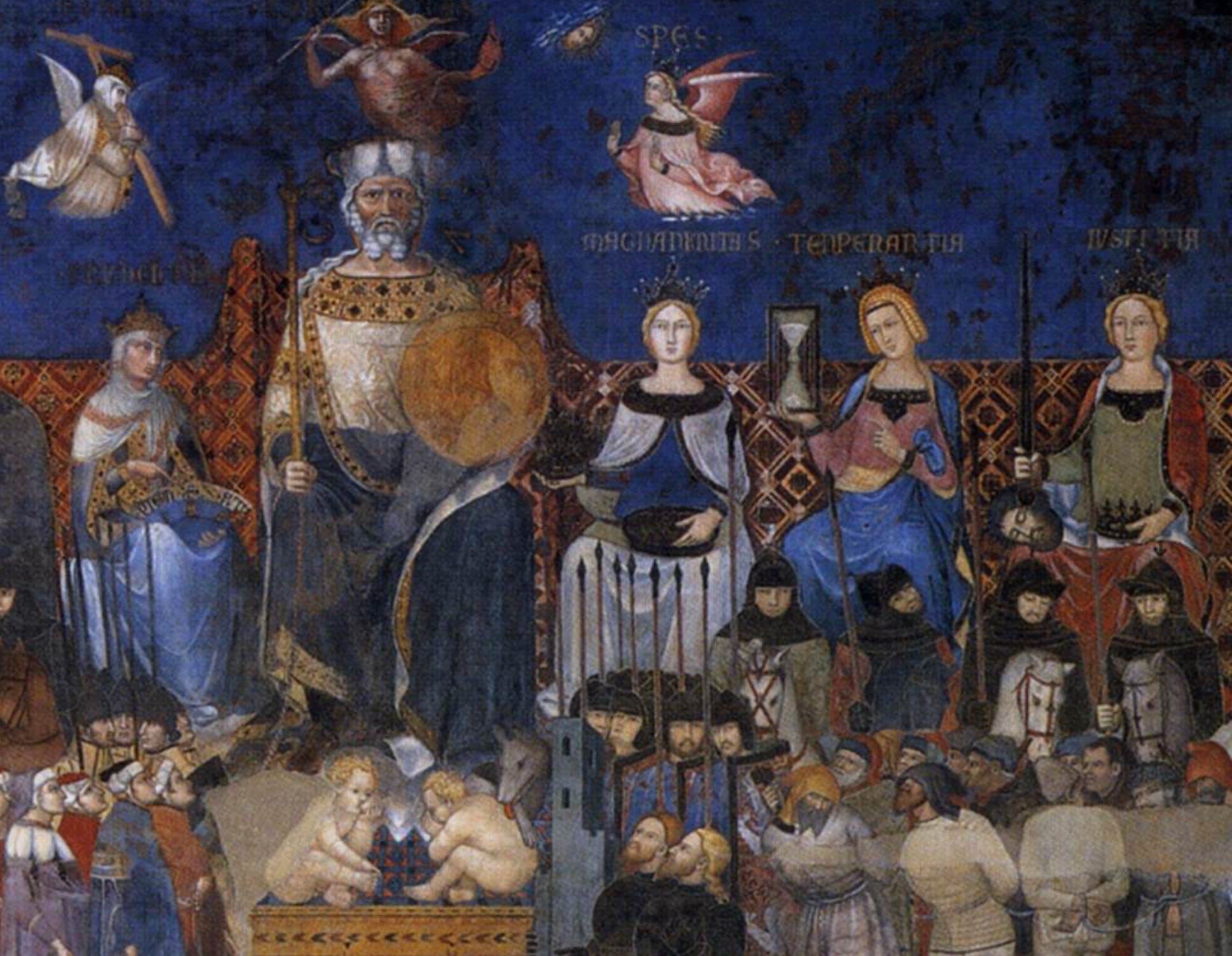
Allegory of Good and Bad Government, Ambrogio Lorenzetti, ca. 1340.
In Marx’s telling, the proletariat replaces Plato’s kings as history’s chosen people, capitalism’s contradictions replace moral degeneration as the engine of change, but the underlying structure remains identical. History unfolds according to discoverable laws toward a predetermined end. The role of the “scientific socialist” is not piecemeal reform (Marx derides that as “utopian”) but rather to announce the inevitable revolution and to “shorten and lessen its birth-pangs.” On this view, the inexorable laws of history grant theorists the power to “see what is going to happen,” as Popper has it, so allegiance to the proletariat becomes a matter of “scientific foresight, on scientific historical prophecy.” Meanwhile dissent from such inevitability is dismissed not simply as a lack of compassion and solidarity with the working class, but scientifically wrong, one that can be proven so by economic facts.
Whether the mandate is to freeze decay (Plato) or accelerate revolution (Marx), the means converge: power concentrates in those who know history’s laws, while those who resist the inevitable become not political opponents but enemies of a science itself.
It’s not hard to see this historicist thinking saturating contemporary discourse, especially among Marxists who read social decline as the necessary outgrowth of material inequalities (a view I’m not unsympathetic to). But many of today’s most influential storytellers package history as destiny. Consider dizzyingly popular Yuval Noah Harari, who tells millions that “there is no way out of the imagined order,” that “when we break down our prison walls, we are in fact running into the more spacious exercise yard of a bigger prison.” Steven Pinker likewise casts the modern state as evolution’s inevitable remedy for an inherently violent nature, essentially repackaging fate as social science. As David Graeber and David Wengrow note in The Dawn of Everything, the most popular historians today have “captured the prevailing mood” that humanity is “well and truly stuck.”3
On Popper’s account, then, authoritarianism is not cosmically inevitable. It becomes likely when elites and citizens internalize its prophecy and treat coercion as obedience to historical necessity.
Historicism mistakes the past for the future and makes the present a handmaiden to both. For Popper, the great danger here is how such thinking transforms citizens from actors into pawns. By postulating laws on the development of society, the historicist offers the solace that events, however catastrophic, are predestined. If events, such as a “lapse into totalitarianism” are “bound to happen whatever you do, then you may feel free to give up the fight against them.” On Popper’s account, then, authoritarianism is not cosmically inevitable. It becomes likely when elites and citizens internalize its prophecy and treat coercion as obedience to historical necessity.
This kind of fatalism sits uneasily with Popper, because it relieves people “from the strain of their moral responsibilities.” If history unfolds according to law, individual choices become meaningless, moral agency evaporates, and political engagement reduces to either accelerating or resisting the inevitable. A citizenry thus sacrifices moral self-determination for spurious intellectual certainty, trading the consciousness of being “the makers of our fate” for the passivity of being history’s mouthpieces. Worse still, such prophecies become self-fulfilling. Those who declare democracy’s death inevitable “discourage those who fight totalitarianism” thereby hastening the very collapse they predict. Popper, like Cassius, believes “the fault, dear Brutus, is not in our stars, but in ourselves.”
Vico’s Barbarism
Yet if the fault is indeed in ourselves, why do so many republics decay in familiar ways? What explains the recycled plot of history if not a law? One can concede that the frequency of authoritarian turns does not, by itself, entail that the United States must share that fate. Still, the pattern is hard to ignore.
Giambattista Vico offers one classic account of why nations may seem caught in such patterns. Though Popper scarcely mentions Vico in The Open Society (he notes him only in a footnote on Hegel), he is nonetheless a pivotal early modern theorist of the rise and fall of nations. In The New Science, Vico argues that history does not advance in a straight line but moves cyclically through corsi e ricorsi, “courses and recourses.” Nations at the end of this cycle enter a phase he calls la barbarie della riflessione, the barbarism of reflection, in which sophisticated societies are hollowed out by an isolated, self-serving, citizenry—only for the cycle to begin anew.
Vico’s corsi e ricorsi maps an “ideal eternal history” through which all nations and peoples pass. The claim to knowing such a law rests on his verum factum principle, the idea that we can know what we have made. Because nations are products of our own making, what he calls “modifications of the human mind,” they are, in principle, knowable by us, the way a clockmaker knows the workings of a clock. Like Popper’s “methodological essentialism,” one can know this history and predict it in advance. We can discern a recurrent order by studying the forms we ourselves have made. On this view, the regularities of decline are intelligible because the makers of history, us, keep remaking them with the same human materials.

“Time is a flat circle.” True Detective, 2014, HBO.
Vico offers a three-age course (corso) through which all nations pass. The first is the Age of Gods, a dark and terrifying world in which nomadic tribes are governed by terror and superstition, believing all natural events are divinely decreed. Next comes the Age of Heroes, which ushers in aristocratic rule, where self-proclaimed descendants of gods enforce their will through force and religious custom. Finally, the Age of Men ushers in human governance with republics or monarchies built on recognized human equality and rational law.
Yet this progress carries its own undoing. When nations reach the refined heights of the Age of Men, society dissolves into the barbarism of reflection. This stage is characterized by a societal decadence achieved when humans turn their capacity for reason away from public duty and towards purely self-serving ends. This era of barbarism is one in which people “plot against the life and fortune of friends and intimates,” even “under soft words and embraces.” Pride and arrogance are taken to be virtues, and people “bristle and lash out at the slightest displeasure.” The poverty of spirit is matched only by the isolation of its people. As Vico notes, despite physically “thronging together” in polished cities, people live in an “extreme solitude of spirit and will,” rendered incapable of agreement because each citizen pursues “his own pleasure and caprice.”
As consensus and goodwill collapse, the civic order tips into “total disorder,” shifting from “complete liberty” to “complete tyranny,” the worst tyranny of all being anarchy. By anarchy he means the “unchecked liberty of free peoples,” a condition in which there are “as many tyrants as there are audacious and dissolute citizens.” At this point, society succumbs to “obstinate factions” and “desperate civil wars,” which ultimately destroy the state from the inside.
What could better exemplify Vico’s extreme solitude of spirit than the rise of AI companions—perfectly agreeable digital relationships that never challenge our opinions? Certainly!
Vico never uses the phrase authoritarianism (he’s writing in 1744), but his barbarism of reflection feels eerily prescient in our present moment. Today’s citizens, encouraged with arguments to justify base impulses, scroll through endless feeds of outrage while gathering in digital crowds to pursue private pleasures. What could better exemplify Vico’s extreme solitude of spirit than the rise of AI companions—perfectly agreeable digital relationships that never challenge our opinions? Certainly!

Elon Musk’s AI chatbot, Grok, offers a new digital companion. Grok, xAI — via Yahoo News.
To understand Vico’s corsi e ricorsi, one can think of ancient Rome. It begins in the Age of Gods, mythic centuries when, as Vico says, “gods consorted on Earth with heroes.” The Age of Heroes begins with Romulus and the patrician aristocracy, where noble families, claiming divine descent, rule through reference to their consort with the gods. The Age of Men dawns with written law. In Rome’s case, this is the Twelve Tables (carved in stone about 300 years after the city’s founding).
The laws are soon followed by reforms that widen commoners’ standing and consolidate what we typically think of as the Roman Republic. Yet these very reforms accelerate decay, as Vico sees it. For example, when the Gracchi brothers propose redistributing land to poor Romans, both end up murdered in the streets, their deaths teaching Rome that the sword is mightier than the pen. Law breeds abuse of power; civic society breeds demagogues; prosperity breeds private greed. As in Rome, faction hardens into militias and the Republic is seized by civil wars, after which there is collapse into darkness.
Then comes the ricorso, the return. When barbarism breaks the polity, survivors fall back to what Vico calls the “sheer necessities of life.” Civic order is renewed by three traditions: piety, marriage, and burial. These are less traditions per se and more metonyms for an acknowledgment of a higher claim, an emphasis on kinship, and a respect that eventually we will die. As Owen Barfield renders Vico’s warning: “Let him who would transgress them beware lest he transgress all humanity.”4
Is It Inevitable?
Like Hamlet, we risk becoming paralyzed not by ignorance of history but by too much knowledge
So is this cycle inevitable? Vico’s answer is paradoxical. History, he insists, had, has, and will have to be (dovette, deve, dovrà). This is our shared fate, one which binds us to the Romans as much as to the Sumerians. However, this necessity operates not through fate but through the consistency of human choices. He writes of this cycle, “men did it with understanding... with choice.” But the choices always follow the same pattern: “Men first feel necessity, then look for utility, next attend to comfort, still later amuse themselves with pleasure, thence grow dissolute in luxury, and finally go mad and waste their substance.”
Perhaps then we can find a middle ground between Vico and Popper. America’s descent into authoritarianism is not inevitable, but it is predictable. Yet Popper’s warning remains equally vital. To declare democracy’s death inevitable is to hasten its arrival, to transform citizens from actors into spectators of their own destruction. The danger isn’t that we’re trapped in Vico’s cycle but that we might trap ourselves by believing we are.
There’s that old saying ‘those who don’t know their history are doomed to repeat it,’ but it’s just the opposite. Like Hamlet, we risk becoming paralyzed not by ignorance of history but by too much knowledge. Seeing all the patterns, knowing all the precedents, understanding exactly how republics die, we continually find in that understanding an excuse for inaction. “Thus conscience does make cowards of us all,” the prince says, if not cowards at least fatalists.
If this is right, then our task is neither to deny the patterns nor to surrender to them, but to use our knowledge of democratic fragility as a spur to action rather than an alibi for neglect. The cycles Vico identified are real, but they’re human cycles, born of choice rather than fate. And if they’re born of choice, then different choices remain possible—difficult, unlikely perhaps, but possible nonetheless. The barbarism of reflection may be where societies tend to arrive, but tendency is not destiny. Not yet anyway.
Karl Popper, The Open Society and Its Enemies, new one-volume ed., intro. Alan Ryan, essay E. H. Gombrich (Princeton, NJ: Princeton University Press, 2013)
Giambattista Vico, The New Science, trans. and ed. Jason Taylor and Robert C. Miner, introd. Giuseppe Mazzotta (New Haven: Yale University Press, 2020)
David Graeber and David Wengrow, The Dawn of Everything: A New History of Humanity (New York: Farrar, Straus and Giroux, 2021). For more on critiques of historicist thinking as it relates to facism, see How Republics Die: Creeping Authoritarianism in Ancient Rome and Beyond, ed. Frederik Juliaan Vervaet, David Rafferty, and Christopher J. Dart (Berlin: Walter de Gruyter, 2025)
Raymond Barfield, The Ancient Quarrel between Philosophy and Poetry (Cambridge: Cambridge University Press, 2011)